

When Hard Work Becomes Abuse
Plus: a checklist to bring into your next interview


There were many stories that were told over the course of my interviews that really affected me. One person told me that while their kids were 1 and 3 he was expected to hop on a plane to San Francisco with as little as 30 minutes notice, on almost a weekly basis. Another woman I spoke to told me about the expectation her CEO held for her availability on business trips, with her hours generally working out to 19-20 hours a day. A third told me about the palpable tension in the office whenever their Founder appeared, because he seemed to only come to the office when he wanted to yell at someone, leaving shortly after the reaming out was concluded. A fourth told me that their Founder questioned their commitment to the organization because she would not forego attending her sister’s wedding, an event she had registered 6 months in advance, in order to attend a quarterly off-site and continuously pressured her to change her mind. While these people were in these orgs, they accepted this treatment as par for the course. Why? Why do so many people at early stage companies allow this to happen to them?
Every single product leader I spoke to said that accepting a full-time position at a start-up is tantamount to signing their life away. The veteran early stage operators understand this about early stage company culture, and love it. They don’t want to do anything else, they want to work hard and create growth. It is their passion. There isn’t really a concept of “hours,” you work constantly, forming your life around the needs of the organization. You can expect calls at all hours, weekend sessions, constant travel. The intensity of the work is also noted, with many of my interviewees saying you cannot avoid being completely consumed, mentally and sometimes emotionally by the job. Side hustles are parked, hobbies fall by the wayside. If you are looking for work-life balance, the overwhelming sentiment was that you shouldn't look at an early stage company.
As an industry, tech workers are particularly primed for this type of work culture. It’s been pushed at us through general rhetoric, the Steve Jobs biography, movies like The Social Network, shows like Silicon Valley. So much so that the line between a total commitment to success and accepting, occasionally volunteering for, abuse is blurred into a fine mist. As I finished my series on Founders, I was left wondering which direction I should head to next in terms of my findings, and I found myself coming back to a particular conundrum that Product Leaders face when joining an early stage company; when does the hard work slide into dysfunction, and when does dysfunction slide into abuse?
A product leader often finds a combination of three realities when they join an early stage company. Depending on who is in the Driver’s seat, these three states can form a slope coated with oil. There is the aforementioned Hard Work bucket, bred by the urgency of a shrinking runway and the need to show value creation in order to secure more funding. Then there is the Dysfunction bucket. Dysfunction is present at pretty much every early stage company in varying degrees for a lot of potential reasons; chaotic atmosphere, young employees, immature leadership, a lot of egos, politics. Dysfunction being present doesn’t automatically place an org in the toxic wasteland bucket, but it does mean that incoming employees need an extra layer of self-awareness and rigour to navigate successfully. Finally, we have the Abuse bucket. As things get more and more dysfunctional, workers often experience the frog in a boiling bucket of water syndrome. The heat slowly gets turned up, and the frog slowly adjusts until it’s too late for them. A lot of people can put up with a lot of really abusive behaviour, but they should never have to.
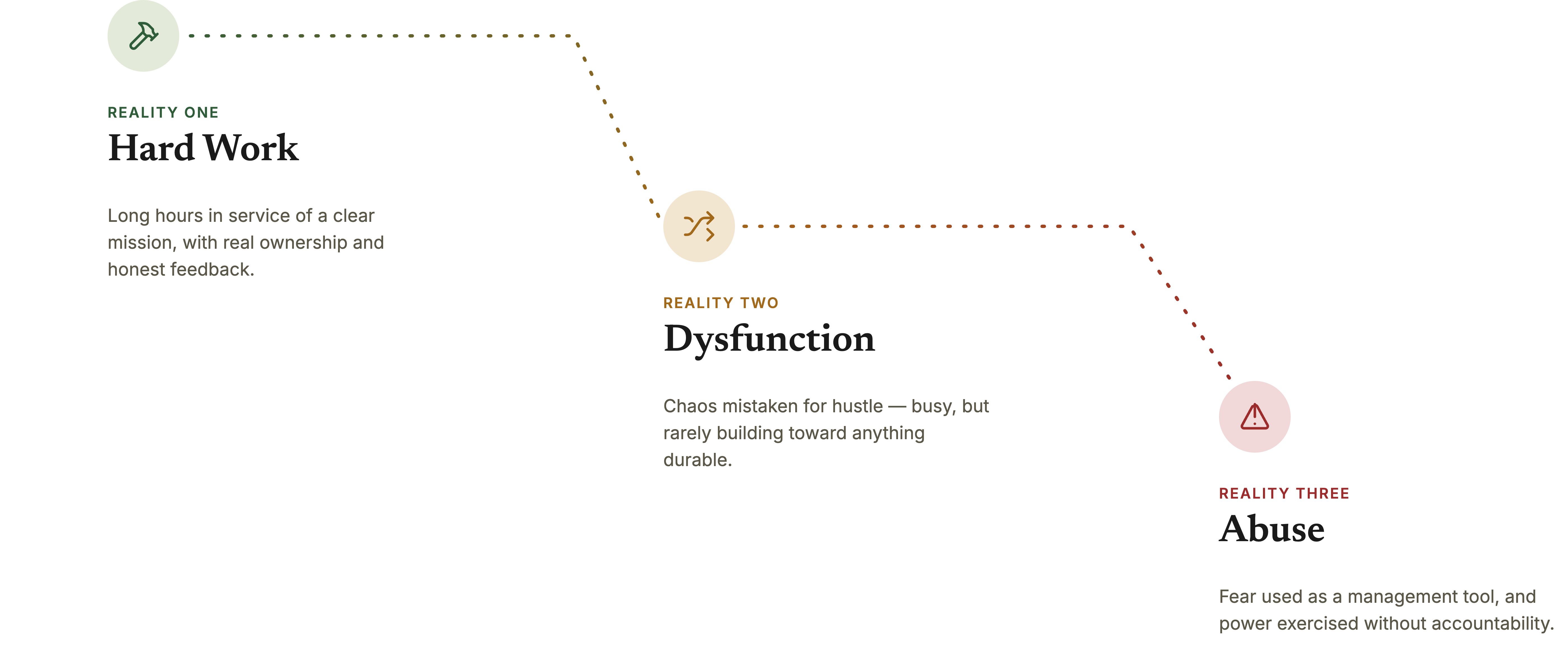
I would say that the key differentiator between the hard work that a product leader must expect at an early stage company versus the other two buckets is whether it feels you are pulling the cart (a rickety, unwieldy cart) up the rocky road together, or are you engaged in the Sisyphean task of rolling a boulder up a hill alone, only to have it roll back down again at the end of the day, while your peers or bosses chuck rocks at you?
I’m going to reiterate this again, as it’s a big drum I’ve uncovered and really enjoy banging, early stage companies are on a spectrum. Our task, as we are evaluating whether to join, is to understand if we are entering an environment that is WILLING and ABLE to support the work we are there to do as product leaders. If you find yourself in a toxic wasteland organization with a toxic founder, not only are your chances of succeeding there greatly diminished, but the likelihood that you will come out of the experience a burnt-out shell of a human is pretty good as well.
So what’s a Product Leader to do? How does one approach a job that at best is going to consume 100% of your brain energy, and at worst crush your soul? to out-source as many life admin tasks as possible. I upped my cleaning woman to once a week, and paid her for extra hours to handle laundry and organizing. I found a neighbourhood kid and paid him to walk my dog twice daily. Groceries were delivered. Other product leaders I spoke to hired remote personal assistants that they could delegate to. Many made sure that they had a life or professional coach in place so that they had a sounding board and a place to work through friction. Speaking very honestly, the majority of the men in this position had wives, and while it was difficult to sacrifice time with their family, much of the life admin tasks were off their plate anyway.
In terms of the all-consuming hard work, what I heard from the product leaders, and the strategy that I tried myself, was attempting
In terms of the dysfunction, it’s present at every company to varying degrees. First make sure you have the confidence and the ability to rigorously interrogate the organization you are thinking of joining. In subsequent posts I’m going to be talking a lot about how to understand an org’s culture, politics, and general relationships. We have already covered in-depth how to understand if you have a rotten core in the Founder. The other important thing I can stress is understanding your own damn self. As the great Peter Drucker has said, “Before you lead others you need to manage yourself.” Are you able to choose how you react? Can you encounter friction with curiosity and empathy? Do you have the ability to set clear boundaries on what you will and won’t sacrifice? Are you able to care less and pick the most crucial battles to fight? Not exactly sure who to attribute the great phrase, “what you allow is what will continue,” but often at organizations I’ve seen two people have two completely different experiences because of differences in experience, maturity and self-worth. I try to ascribe to the sentiment of my girl Jane Austen who wrote “I always deserve the best treatment, because I never put up with any other,” with varying degrees of success.
Finally, if you find yourself in the boiling water of an organization that is abusive, what do you do? The hard truth is that the organization is not going to change, but abusive early stage companies stem from the Founder, who is either creating it, or allowing it. So when you understand that it’s happening, you leave. Life is too short, and no job is worth it. I leave you with this, abuse is rarely a recipe for success, and even on the rare occasion where success and abuse cohabitate, success usually happens in SPITE of abuse rather than because of it.
Below is a list of questions to ask of Founders, or current/former employees that will give you some insight into whether an organization flirts with abusive behaviour.