
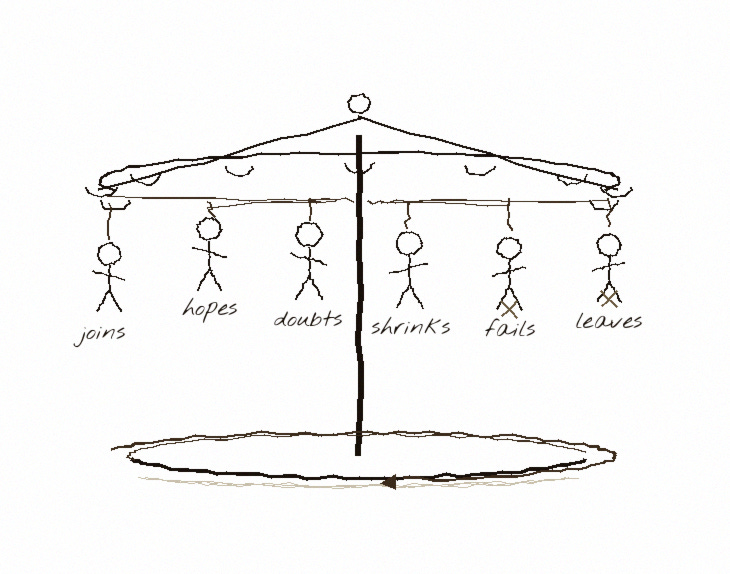
The Problems Carousel
We have just been passing problems around, hoping they would get better.

We're captive on the carousel of time
We can't return we can only look
Behind from where we came
And go round and round and round
In the circle game. — Joni Mitchell
In nearly half of the interviews I conducted, somewhere near the end, the subject would lean in and ask me the same question: 'Now that you're getting a look from the balcony, can you tell me why does this keep happening?' This sentiment was expressed multiple times in ways that really made me sit up straight.
Dan Storms remembered in his interview a killer blog by Casey Winters titled “Why Product Leaders Fail” which summarized how most Product Leaders feel about their startup experience “you just try to put some points on the board before you inevitably get fired.” Dan himself went on to say, “we keep doing this over and over again, I can’t figure out why.”
Emily Tate shared her perspective on what’s happening as product leaders rotate through these roles; “particularly in product leadership, you go into a company that you know is broken, but you have some fresh energy. You do everything you can to improve it little by little, until it burns you out. You leave and somebody else comes in with fresh energy, picks up where you left off, and goes little by little until they can't do it. And you take your fresh energy to go to a different problem that is also broken…we are just rotating through each other’s broken roles.”
This assessment was perfectly mirrored by another of my subjects who needs to remain anonymous because his tech community is quite insular. He was speaking with a product leader he mentors. “She'd been at a startup for two years…she was supposed to be the leader, but she went in…got no traction…so she burnt out and after about two years, she eventually quit.” He was then contacted by another person in his network about that very job. His mentee was too afraid to speak openly about her bad experience, so my subject was only able to pass forward this cryptic advice, “The best advice I can give you is I've heard that the CEO can be challenging. Figure out how challenging, by talking to other people that you know are there today or have left that will speak to you before you accept any job.”
So round and round we go, in a hellish circle of ignorance, not able to address the root problem, not even able to really acknowledge the problem exists at all. Somewhere along the way, we have all absorbed that if the problem exists, it must be us. It is certainly what I thought in the thick of my crappy, often abusive start-up experience. I felt isolated in my failure, and scared to talk about it. Even years later, I have felt the hot shame radiating out of my chest. Yet, these interviews revealed for me, definitively that the challenges that product leaders encounter ARE structural, and this is why they keep happening.
When I say structural, I mean that the conditions that make product leadership precarious in early stage companies exist independent of who walks in the door. They were there before you arrived. They will be there after you leave. That doesn't mean product leaders are blameless, every person that I spoke to bemoaned the mistakes that they made. But here's what my research made undeniable: even the most seasoned, self-aware leaders in my study, people with tons of experience, still failed in difficult environments. The structure has a weight of its own. What experience and maturity give you is a better chance of navigating it, and a clearer understanding of when the ceiling is the ceiling, and no amount of skill is going to move it.
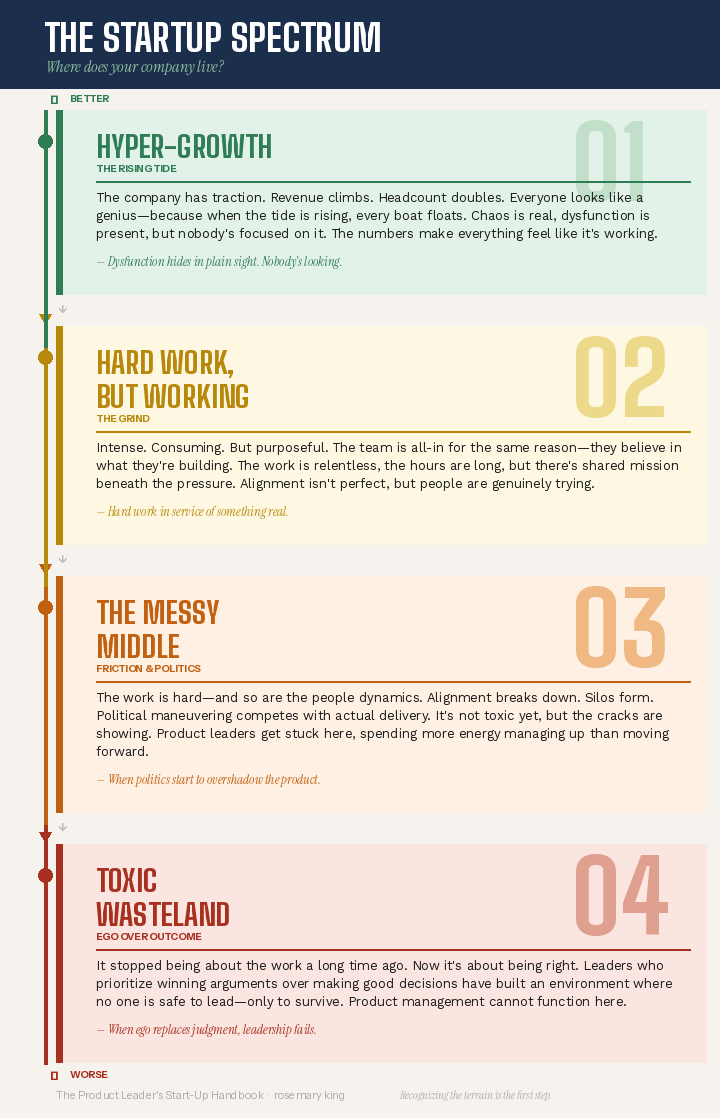
If structural conditions are what determine how hard the fight is going to be, then the most useful thing I can offer you a map of those conditions, as seen below. Not all startups carry the same structural weight, and understanding where a company sits on this spectrum is the difference between walking in prepared and walking in blind. Of the 23 leaders I spoke to, virtually all had experienced both ends of the spectrum, at least one startup that ground them down, and at least one that they'd do again in a heartbeat.
Hypergrowth Companies
As in so many situations in life, success and money can gloss over most sins. If you happen to find yourself on a rocketship, aka a company that is experiencing hyper-growth, say a Netflix in 2008, or a Spotify in 2014, then dysfunction is slightly less material, because there is less blame being passed out. Everyone looks good, because the company is growing. As one of my interview subjects said, “If you happen to be on a rocketship, you don’t worry about what seat you’re in, you just get in and hang on for the ride.” The companies are career makers, and being in one at early doors is a golden ticket.
Hard work, but working
Next, you have a more common scenario, one which many of my interview subjects were currently in, the startup that are slogging, but focusing on the right things. To be clear, and I will be discussing this point several times over the course of this project, working at an early stage company, whether it be just getting going, or attempting to scale, is INTENSE. But if the team is communicating, putting egos aside, focused on using data to build consensus and make decisions, and using critical thinking to evolve ways of working, then that’s a good scenario. It does not mean that the startup will succeed in the end, but it will be an experience that folks look back on with satisfaction.
The Messy Middle
These are organizations that are beginning to fight against themselves, allowing the focus to be drawn away from the key question of how to create value, and get distracted by issues of ego. Typical problems include lack of clarity around direction, politically motivated decision making, one function obstructing another, the list goes on. This is the most common scenario in general, and I believe through my research that startups are more likely to be messy for product leaders. Why? Because there is no set role for a product leader. This is something I’m going to be covering extensively throughout the course of the project, but no one, often not even product leaders, understand the certain boundaries of what their role is supposed to be. As Allen Yang opined “so many factors are just going to be so idiosyncratic to the company. That highly influences the product leader's day to day, like what kind of decisions they make, what they spend emotional energy on. It just feels so idiosyncratic. So it's almost like... does anybody really know?”
The Toxic Wasteland
The final category is not simply dysfunctional. Product Leaders know when they are in the red zone when it feels that there is no direction to move. The sentiment that came out of the mouths of my interview subjects on 15 different occasions can be boiled up to “I’m damned if I do, and I am damned if I don’t.” Here is a sprinkling of the quotes that evoke this idea.
“Me just kind of like working myself to the bone, trying to establish trust and show that I can get stuff done so that I can build some social capital and eventually be able to settle in. But then that doesn't actually help me because what I really need to be doing is showing them the woods for the trees.”
“If we do our job well, sometimes it highlights other people's failures. And if we do our job poorly, then obviously we're going to get blamed."
"If I try to be too flexible, the product is going to fail. But if I stand my ground, I'm going to get fired."
“I was damned if I did and I was damned if I didn't. Because I've now got this guy reporting into me who's being demoted. And if I am successful in anything, it highlights his failure."
The carousel keeps spinning because of collective silence. NDAs, shame, reputational fear, and the insularity of tech communities mean the hard-won knowledge of every product leader who’s been through a difficult startup evaporates. It never gets passed forward. And the next person walks in blind.
One subject put it poignantly: “I was talking less in meetings. I realized whenever I talked in a meeting, it would backfire. From my perspective, whenever I said something, I felt like I was getting negative feedback. So I was just decided I’m not going to talk.”
The silence in that last quote has stayed with me. She didn’t go quiet because she had nothing to say. She went quiet because doing her job had become dangerous. I know that feeling. A lot of us do.
Each week, I'm going to take one of the structural challenges my research surfaced and pull it apart properly. What it looks like on the ground. How to spot it before you walk in the door. What the leaders who navigated it well actually did, and where even experienced leaders got it wrong. Challenge, what to look for before you walk in, what works, and what doesn't, in that order.
I won’t promise it will keep you safe. Some of these organizations will eat you alive regardless of how prepared you are. But you deserve to walk in with your eyes open. And the people behind you deserve better than a cryptic warning about a challenging CEO and a prayer. This is the knowledge that should have been passed forward all along. It just never was.